Sixth edition of the training program on European Integration for public officials started at the College of Europe in Natolin with the EU support
05.03.2026
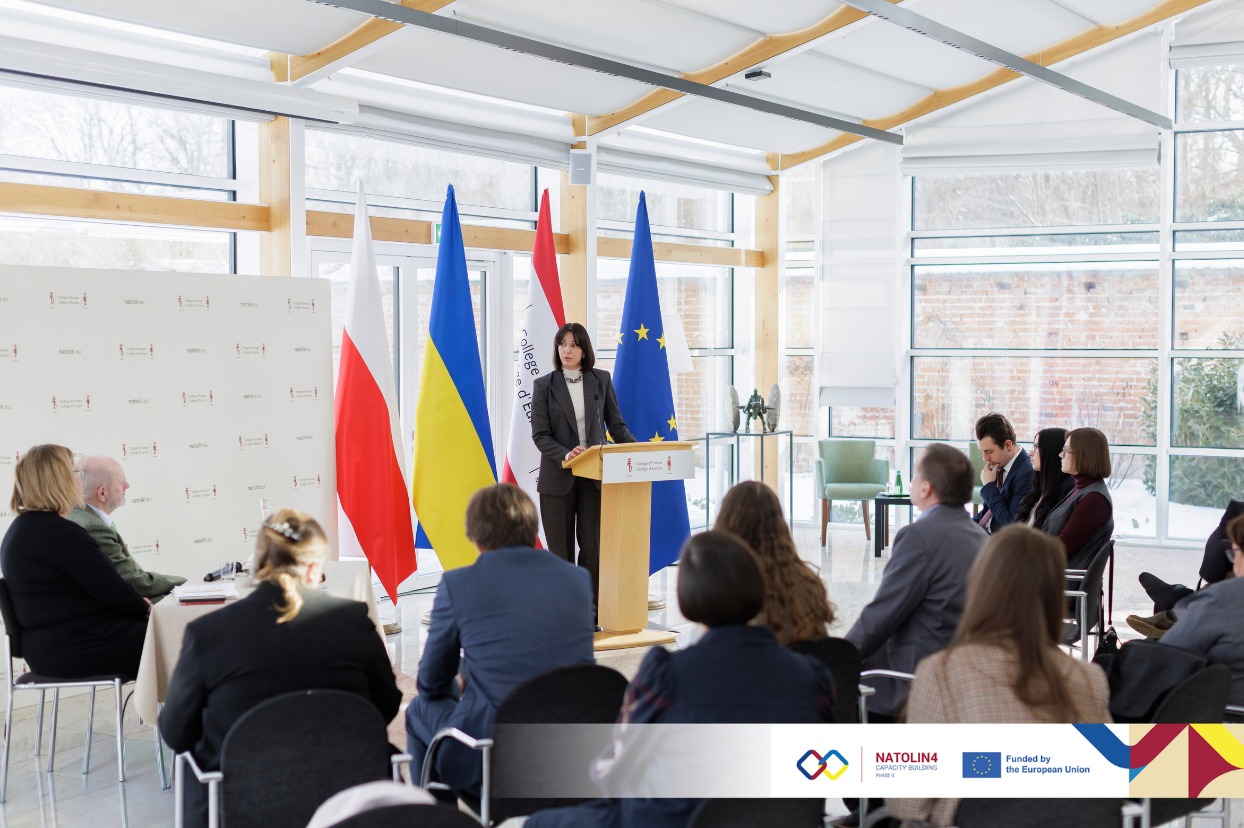
The EU-funded Natolin4Capacity Building Phase II (N4CB-II) project has concluded its fifth training edition and is proceeding with the launch of its sixth edition, scheduled to commence in March 2026. The two events mark a continuity in the programme’s structured delivery of capacity building support to Ukrainian public administration in the context of EU accession.
5th Edition: Cluster 5 – Resources, Agriculture and Cohesion
The fifth edition of the Tailored Onsite Knowledge and Analytical Skills Programme on European Integration was held at the College of Europe in Natolin (Warsaw, Poland) from 12 January to 20 February 2026. It was focused on EU accession negotiation Cluster 5 – “Resources, Agriculture and Cohesion”, addressing EU policy areas related to natural resource management, agricultural policy, regional development, and cohesion policy instruments, all of which are relevant to Ukraine’s progressive alignment with the EU acquis.
Eight Ukrainian public official took part in this edition representing:
- Ministry of Economy, Environment and Agriculture of Ukraine;
- State Audit Service of Ukraine;
- State Service of Ukraine on Food Safety and Consumer Protection;
- Government Office for Coordination of European and Euro-Atlantic Integration;
- Ministry for Communities and Territories Development of Ukraine;
- Ukrainian National Office for Intellectual Property and Innovations;
- State Agency of Ukraine for Land Reclamation, Fisheries and Food Programmes.
The programme was delivered through a combination of academic lectures, expert mentoring, study visits and analytical exercises, aimed at developing the professional, analytical and negotiation capacities of participants in the context of Ukraine’s EU accession process.
Participants underlined the programme’s contribution to strengthening institutional capacity for Ukraine’s EU accession and its practical relevance for their day-to-day work. They highlighted the value of a structured understanding of EU governance, the accession negotiation process, and the importance of ensuring effective knowledge transfer within their institutions.
“This programme has helped deepen my understanding of how the EU functions. It has also helped me understand, step by step, my own role in the negotiation process.” – Dmytro Sharylo, Ministry of Economy, Environment and Agriculture of Ukraine.
Participants also emphasised the programme’s strong focus on practical application of EU-related knowledge and analytical skills within their institutions.
“I will prepare a presentation for my colleagues on understanding the roles of EU institutions and analysing EU legal acts. It’s important to know which body to approach, as the Council, the Parliament, and the Commission all have different roles.” – Mariia Barbara, State Service of Ukraine on Food Safety and Consumer Protection.
In addition, participants pointed to the programme’s contribution to improving internal coordination and the quality of policy work related to European integration.
“Despite all the standard answers like ‘I will use this in my daily work’—which is obvious—I can now clearly explain to my colleagues how to improve our work, how to apply this knowledge, and where to look for real answers when we need them.” – Khrystyna Skora, Ministry for Development of Communities and Territories of Ukraine.
Finally, participants emphasised the programme’s contribution to fostering sustainable professional networks and institutional cooperation in support of the European integration process.
“Integration requires strong institutions, not isolated experts. I am confident that the personal contacts we gained here will be valuable in the future, and that we will continue to cooperate with one another on different projects related to European integration.” – Olha Zakharova, Ministry of Economy, Environment and Agriculture of Ukraine.
The fifth edition builds on four training editions delivered in 2025, during which 33 Ukrainian public officials completed on-site training at the College of Europe in Natolin. Together, these editions covered the Fundamentals of EU Accession, Internal Market, and Competitiveness and Inclusive Growth negotiation clusters.
6th Edition: Cluster 4 – Green Agenda and Sustainable Connectivity
The sixth edition of the programme will take place from 1 March to 10 April 2026, focusing on Cluster 4 – “Green Agenda and Sustainable Connectivity”. This constitutes the first group within the current project phase to address this cluster.
Eight participants were selected for this edition, representing the following institutions:
- Administration of the State Service of Special Communications and Information Protection of Ukraine;
- Ministry of Energy of Ukraine;
- Ministry of Economy, Environment and Agriculture of Ukraine;
- State Tax Service of Ukraine;
- State Service of Ukraine for Transport Safety;
- Verkhovna Rada of Ukraine;
- State Agency for Energy Efficiency and Energy Saving of Ukraine.
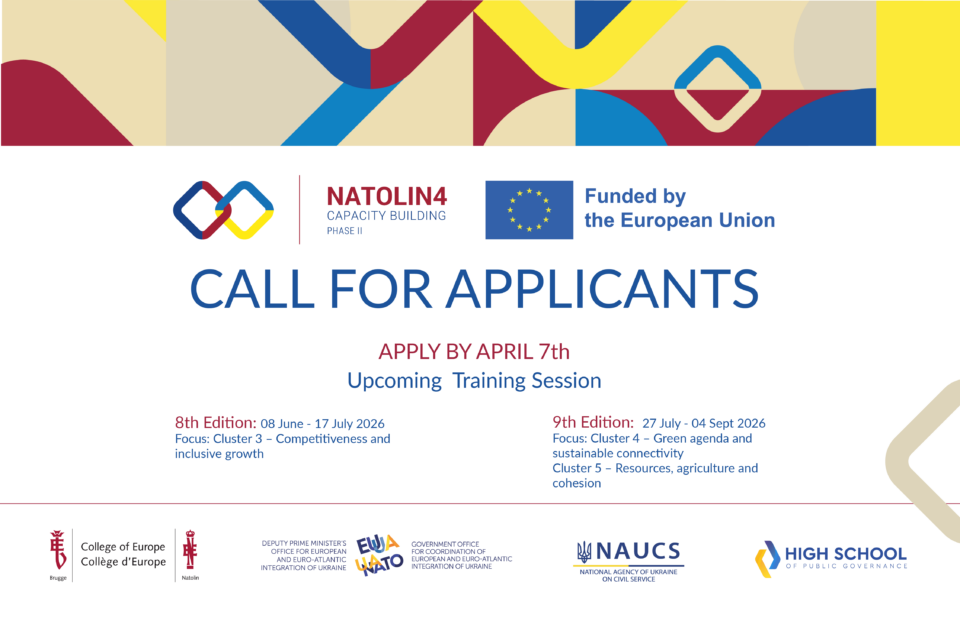
The selection process for the 8th and 9th editions of the programme is expected to open in mid-March 2026. The 8th edition will focus on Cluster 3 – Competitiveness and Inclusive Growth, while the 9th edition will be dedicated to two negotiation clusters, namely Cluster 5 – Resources, Agriculture and Cohesion, and Cluster 4 – Green Agenda and Sustainable Connectivity. Interested candidates are encouraged to follow upcoming updates regarding the application process.
About N4CB-II
Natolin4Capacity Building Phase II — Strengthening Ukrainian Public Administration for EU Integration (N4CB-II) is funded by the European Union and jointly implemented by the College of Europe in Natolin and the High School of Public Governance, in cooperation with the Government Office for Coordination of European and Euro-Atlantic Integration and the National Agency of Ukraine on Civil Service.
Key components of the project include:
- Tailored Onsite Knowledge and Analytical Skills Programme on European Integration for 100 selected Ukrainian public administration employees at the College of Europe in Natolin;
- Training of Trainers module for 36 public administration employees;
- 21 customised e-learning courses on European integration, including 5 newly developed ones;
- Onsite intensive training sessions in Kyiv, reaching 90 participants;
- Expert-led webinars on key EU integration topics.